Australia is more than just a country; in many ways, it is a small reflection of the world itself.
Today, people from more than 190 different countries live across this island continent, either as citizens or migrants who have made Australia their home.
More than 200 different ethnic backgrounds are represented across the country, and over 300 languages are spoken in everyday life. Alongside English, hundreds of other languages can be heard in streets, schools, workplaces and public spaces.
From Europe to Asia, from Africa to the Middle East, Australia is a vast human mosaic.
According to 2024 figures, around 8.6 million Australians were born overseas.
That represents approximately 31.5 per cent of the population.
At the 2021 Census, the figure was 27.6 per cent.
That increase shows just how much migration continues to shape and energise Australian society.
Alongside Christianity, faiths including Islam, Buddhism, Hinduism and Judaism all have a place in this country.
In Sydney, mosques continue to open; on Fridays, Muslims stand shoulder to shoulder in prayer.
At the same time, in the same city, churches fill on Sunday mornings.
The faiths may be different, but the search is often the same: peace, justice and humanity.
Australia’s diversity has been supported by government policies that have remained broadly consistent, even as governments have changed.
Harmony, coexistence and mutual respect are not simply words; they are values that become meaningful when they are lived — in neighbourhoods, classrooms, workplaces and the ordinary encounters of daily life.
But from time to time, people with harmful intentions, from within or outside the country, try to disturb that peace.
That was also the aim of the Bondi attack:
To shake Australia’s image as a safe, free and tolerant country.
To bring hatred, hostility and terror into this society.
Violence and terrorism have no place in any faith.
Neither Islamophobia nor antisemitism has any place in this world.
Multiculturalism is not only a social reality in Australia; it has long been supported as a matter of public policy and held up as a model internationally.
At both federal and state levels, ministers, institutions and public policies work to protect and strengthen that framework.
This mix of languages, beliefs and cultures living under one national roof is not only one of Australia’s social strengths; it is also an important part of the country’s economic and cultural strength — a reminder that diversity can become a shared resource when people are given the chance to participate and belong.
Sometimes, however, you do not need hundreds of pages of reports, census figures or parliamentary speeches to understand Australia’s multicultural story.
Sometimes it is enough to look at a doctor who has spent years studying, yet ends up driving an Uber.
Sometimes at an engineer who spends years waiting because of the requirement for “local experience”…
And sometimes at a Syrian migrant who, while bullets were flying in Bondi, chose to move towards the attacker rather than away from him.
One story shows us the barriers the system places in front of migrants.
The other shows us how, despite those barriers, migrants can develop a deep sense of belonging to this country.
Together, the two stories leave Australia with the same question:
Does this country truly recognise the human potential it already has — and does it give that potential every reasonable chance to flourish?
Australia is one of the world’s most successful multicultural societies.
Millions of people from almost every corner of the world share the same cities, the same schools, the same hospitals, the same parks and, most importantly, the same future.
Different languages, religions, skin colours and cultures all meet under the same national roof.
This diversity is not a burden on Australia; it is one of the most valuable parts of the country’s economic, social and cultural capital, carrying with it knowledge, experience, resilience and stories from almost every corner of the world.
But there is also a growing contradiction within this success story.
On the one hand, Australia invites skilled and educated people from around the world.
On the other, it often fails to make full use of their knowledge, qualifications and experience.
That is why the issue raised by former Department of the Prime Minister and Cabinet and Treasury secretary Martin Parkinson is so important.
It exposes a contradiction within a country that has made multiculturalism part of public policy and brought millions of people from different backgrounds together around a shared future.
Doctors arrive.
Engineers arrive.
Teachers, academics and other highly trained professionals arrive.
Yet because of qualification recognition, professional accreditation, licensing requirements and the familiar demand for “local experience”, some are forced to spend years working outside their professions.
On one side, Australia has a shortage of doctors; on the other, migrant doctors struggle to return to their profession.
On one side, schools need teachers; on the other, qualified teachers wait for their credentials to be recognised.
On one side, infrastructure projects, housing construction and demand for engineers continue to grow; on the other, engineers are told they do not have “Australian experience” and end up working outside their field.
Parkinson used a striking metaphor:
The system has become like a river clogged over time with mud and debris.
The water is there.
The source is there.
The potential is there.
But the flow is not.
Or at least, it is not strong enough.
And migrants are not the only ones paying the price.
Australia is paying it too.
When a doctor spends years behind the wheel instead of practising medicine, that is not only a loss to that doctor’s career; it is also a loss to the Australian patient waiting for hours in a hospital.
When a teacher cannot enter the classroom, that is not only the teacher’s problem; it is also the problem of the school facing a teacher shortage.
When an engineer cannot work in their profession, it is not simply a personal disappointment; it is lost productivity for the country.
Bringing a migrant to Australia is not, by itself, success.
Real success is being able to use that person’s knowledge, profession, labour and experience as part of the country’s shared future — allowing ability to become contribution, and contribution to deepen belonging.
But there is another side to Australia’s migration story.
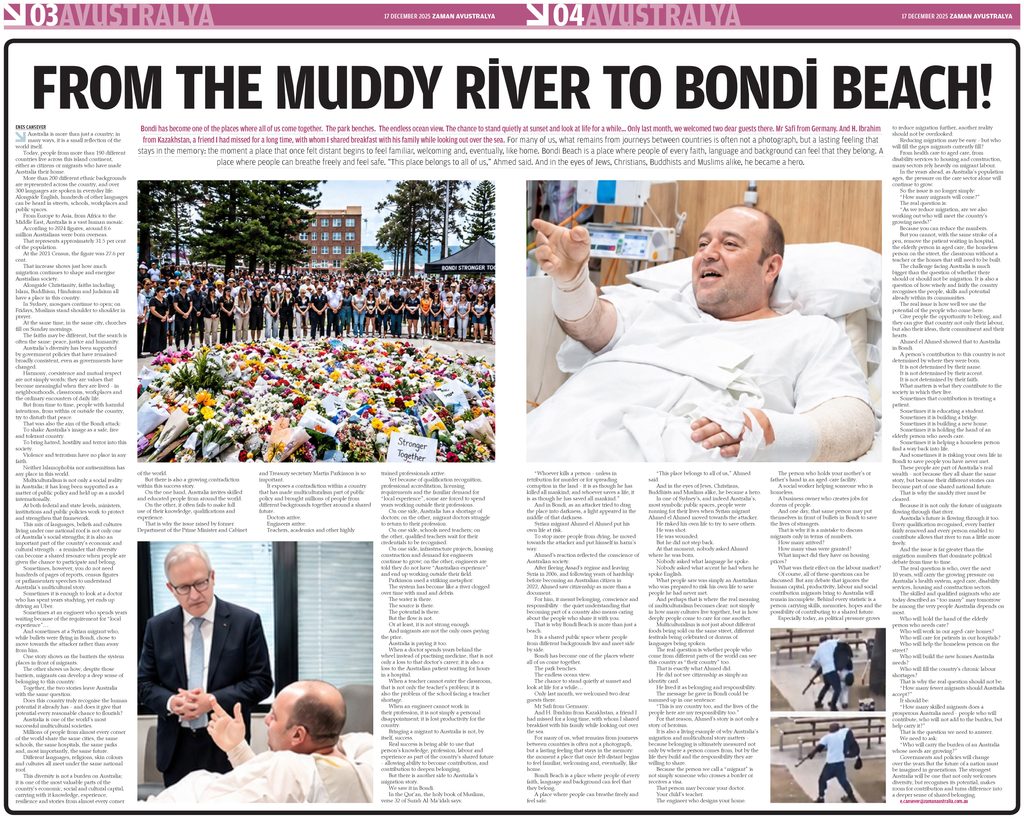
We saw it in Bondi.
In the Qur’an, the holy book of Muslims, verse 32 of Surah Al-Ma’idah says:
“Whoever kills a person — unless in retribution for murder or for spreading corruption in the land — it is as though he has killed all mankind; and whoever saves a life, it is as though he has saved all mankind.”
And in Bondi, as an attacker tried to drag the place into darkness, a light appeared in the middle of that darkness.
Syrian migrant Ahmed el Ahmed put his own life at risk.
To stop more people from dying, he moved towards the attacker and put himself in harm’s way.
Ahmed’s reaction reflected the conscience of Australian society.
After fleeing Assad’s regime and leaving Syria in 2006, and following years of hardship before becoming an Australian citizen in 2022, Ahmed saw citizenship as more than a document.
For him, it meant belonging, conscience and responsibility — the quiet understanding that becoming part of a country also means caring about the people who share it with you.
That is why Bondi Beach is more than just a beach.
It is a shared public space where people from different backgrounds live and meet side by side.